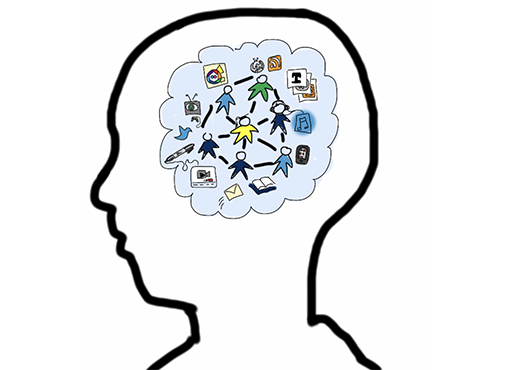
In a society that values constant connection, we often live our lives with a shocking lack of it. Think about it for a second. We as Americans (and truly as global citizens) are plugged in everywhere: phones, feeds, messages, Slack, Email, Instagram, TikTok. Yet, despite this overabundance of hypercommunication, we spend more time pretending to connect than actually understanding ourselves- or each other. Over the years, we’ve forgotten how to truly meet ourselves, and until we do, genuine connection with anyone else remains impossible. When identity becomes a performance, rather than a discovery, everything else- our relationships, creativity, and sense of meaning- begins to fray. In this world of endless attention saturation, the quiet act of knowing oneself is no longer optional; it is revolutionary.
At the beginning of the year, in my English Class, we had the opportunity to discuss AI, algorithms, and explore how Large Language Models (LLMS) are shaping the ways our generation thinks, learns, and communicates, by way of a Socratic seminar. We had a wonderful discussion, but what wasn’t fully addressed, and what haunts me, is the long-term consequences for how we relate to ourselves and others. A 2025 Pew Research Center survey found that about three‑in‑ten U.S. teens use AI chatbots every day, with one-in-five knowing someone or actively being in a romantic relationship with AI. In that same Pew Research study, they found that one‑in‑five teens said they are on platforms like TikTok or YouTube almost constantly. These patterns of use, and honestly abuse, have fundamentally rewritten how we communicate and perceive who we are as people. When much of our emotional and social energy is spent interacting with LLMS and Algorithms, rather than humans, the process of learning to know oneself and others is interrupted. We’re already seeing the consequences of this: teen depression rates have surged in the past decade, with one in three adolescents reporting persistent feelings of loneliness or disconnection with excessive social media use, especially being linked to increased anxiety and lower self-esteem among young people. Our digital habits aren’t just shaping how we communicate-they are shaping how we experience life itself, leaving many of us adrift, strangers to our own minds and to each other.
This isn’t even surprising. I want you to think of Harlan Ellison’s “I Have No Mouth, and I Must Scream”, where AM, the supercomputer, tortures humanity relentlessly, controlling every aspect of its existence. In some ways, our social media feeds and AI companions have become a softer, subtler version of that control. Sure, they aren’t inflicting direct pain on us (yet), but they demand our constant attention, measure our value in likes and engagement, and shape how we think, feel, and relate to one another, without us even noticing it most of the time. Even centuries ago, writers like Virginia Woolf urged us to nurture our interior lives, the quiet spaces of reflection where identity is discovered, and Rainer Maria Rilke encouraged us to “live the questions,” exploring uncertainty and emotional depth as a path to understanding ourselves. Today, those spaces are dead. Instead of listening to our own minds, we respond to notifications, scroll through feeds, and curate our online personas, while algorithms shoot us little bullets of dopamine. What once emerged from reflection, conversation, and shared experience, the ability to empathize, to understand ourselves and others, is now mediated by the eerie incandescent glow of our screens, and cold code behind it. Slowly, but surely, our inner lives shrink, and we risk becoming strangers to ourselves before we can even truly connect with anyone else.
And yet, I think we stand on the cusp of something truly great. Sure, social media will always be omnipresent, and AI is projected to only grow more prevalent, and we can still be tempted to outsource our emotions to AI bots, but even in the midst of that, we still have a choice. I feel it every time I pause, away from the notifications, the reels, the videos, the chatter and noise, and I notice how I actually feel-what I care about, what excites me, what scares me. To love, to be passionate, to act with intention in a world that rewards indifference-these are radical acts. It reminds me of the biblical story of Jonah, swallowed by the great fish and forced to confront himself in the depths of the sea; when he emerged, he had a choice, a second chance to act with purpose and embrace life fully. While by no stretch of the imagination am I Christian, I think that yes, the tools of distraction are everywhere, but so is the power to choose. The power to decide how we live, who we become, and what kind of society we build together. We are on the threshold of this rebirth, and it is up to us to listen to that quiet voice within, the one that says we will feel, we will love, we will act, and that in doing so, we reclaim ourselves. And when we answer that voice, with courage and passion, we do more than survive this age of distraction; we become the generation that dares to fully, unapologetically believe.