Austin High’s location on Town Lake makes it a unique ecosystem for natural life, particularly our avian friends. Our faculty and staff have worked to keep birds around our school through bird feeders and growing plants. While there are a variety of bird species you can find, here are the most common we see flying around:
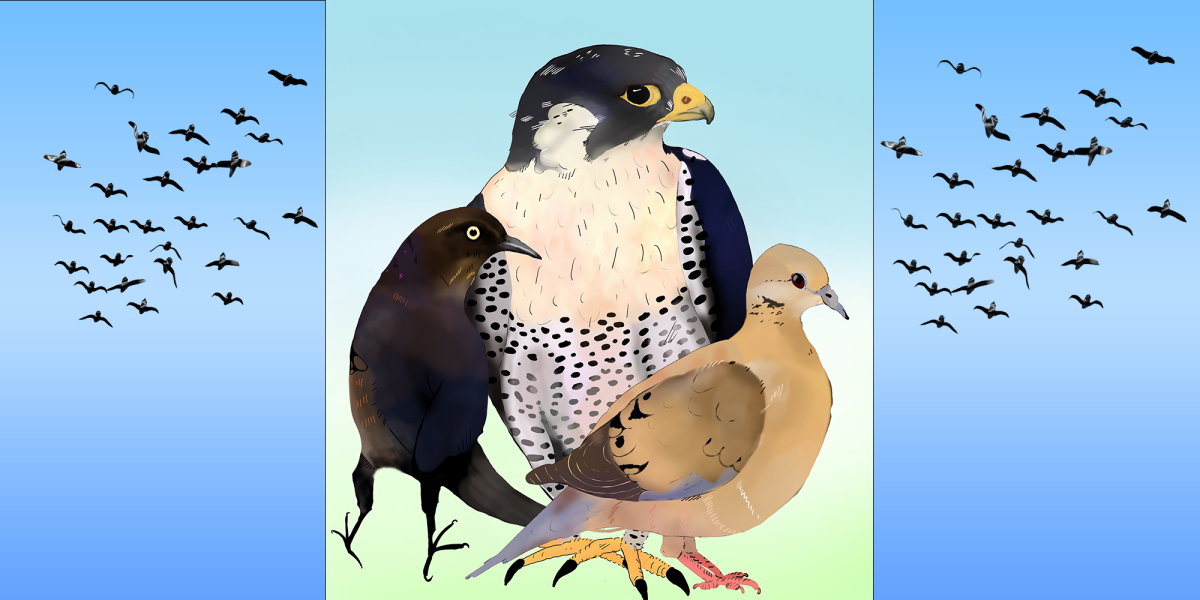
You’re sure to hear the great-tailed grackle all around Austin, North America’s fastest-expanding species. Their name comes from the Latin word “graculus.” These social birds typically fly together in flocks, called a plague, across Texas. In the winter, the number of grackles in these flocks can reach numbers nearing half a million. While these birds are known for their dark black color, their feathers are actually iridescent shades of blue, purple, green, and bronze, most visible in the sunlight.
The state bird of Texas is the mockingbird, which can be found around our high school. These birds can emulate more than 200 sounds and even recognize human faces. Their Latin name translates to “many-tongued mimic.” The expansion of this species is in part due to the rise of the rambler rose, an invasive plant from Asia introduced to the US in the 1700s. Mockingbirds use these bushes to create their nests, featuring berries and branches.
Austin’s beloved mourning dove gets its name from its mournful-sounding call produced by the males to attract a mate. It is one of the most widespread game birds in North America, with over 70 million shot annually, yet natural causes continue to be the greatest cause of death. While there have been doves living upwards of 30 years, they usually only have a life span of a year and a half. The mourning dove is typically monogamous for the entire breeding season, and potentially even longer.
Sharing Austin’s space with their counterpart, the mourning dove, the white-winged dove is often the most colorful bird in Austin’s sky. While they generally reside in the southwest, these doves have been seen across the continent both horizontally and vertically. Due to hunting and habitat loss, the immense 12 million population dropped to 1 million in 1939 within Texas; however, this population has begun expanding, now boasting 2.2 million by the start of the millennium.
Last but not least, Austin is home to the peregrine falcon, the fastest animal alive. These speedsters can reach almost 70 miles per hour when in pursuit of prey. These birds are widespread, being found on six out of seven continents. While these resident raptors are known to migrate through the year, one notable falcon, nicknamed Tower Girl, stays in the University of Texas Tower year round. Fans can observe the bird through UT Biodiversity Center’s live broadcast.
Next time you’re walking to class, look up! You might just see some of Austin’s unique residents.