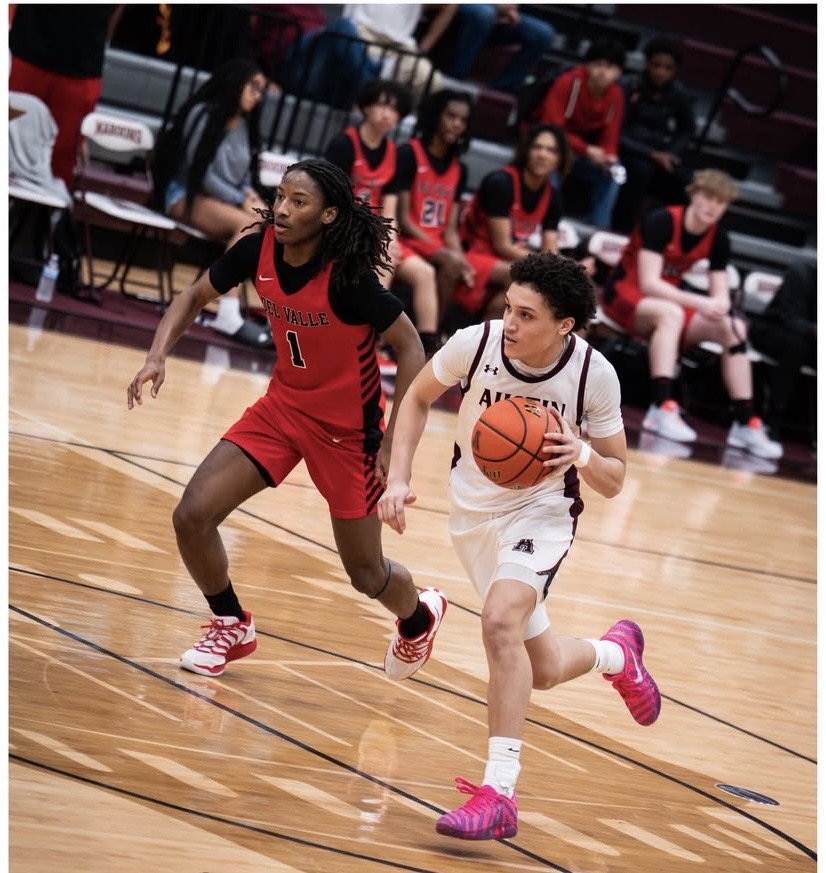
The Austin High men’s varsity basketball team has always been a strong sport for the Maroons, dating back to the school’s opening in 1881. Coach Jones is the varsity head coach who has led the team for the past three years. With the help of assistant varsity coach and JV head coach Coach Davis, Coach Flores, and Coach Kenny. Coach Davis was on the Texas State basketball team. With the basketball season that just happened, it is a relevant time to discuss the varsity season. During the 2024-25 season, the Austin High men’s varsity team ended 7-24, although many of the losses were very close.
The 2025-26 season has finished off with an 18-18 record with wins against McCallum, McNeil, and Alvin, showing much improvement from last year, with the record being 7-24. Placing 4th in the district, the record of games at home was 9-5, and the away record was 3-8. In the final game of the season, Austin High played Akins at home and won in a close game, 64-63, to clinch a playoff spot.
Growing up in Detroit shaped Coach Jones’ early life and ultimately led him toward basketball. “I’m from Detroit,” commented Coach Jones. “Growing up in the city, you’re either going to get caught up in gangs and drugs, or you’re going to gravitate toward sports.”
A key figure in his life was Coach Mathew Nelson, who pushed him to see a future he hadn’t imagined. “He saw more in me than I saw in myself. He gave me the discipline I needed and told me I could go to college, which I had never even thought about,” Jones said.
Despite dropping out in eighth grade and never attending high school, Coach Jones worked hard, played college basketball at Huston-Tillotson University, and even tried out for three NBA combines. “I didn’t go pro, but I told myself that was okay. I wanted to go back and create a new version of myself by teaching others,” he said. That decision led him to coaching at the high school, college, and semi-pro levels before arriving at Austin High.
So how did he balance the demands of coaching with your other responsibilities, such as teaching or personal life? Coach Jones said that balancing coaching, teaching, and family life took time but eventually became manageable. “It used to be hard, but it got easier once I got a system,” he explained. His family’s involvement in sports helped create that balance. “My daughters graduated from here—Paige and Payton Jones—and both played tennis in college. That was one of the reasons I stopped coaching college because I wanted to support them,” he said.
Teaching in the Delta program also plays a big role in his daily routine. “Being in Delta helps a lot because I’m able to help students get their credits and move on. That’s important for me to see,” he said. “I get here around 6 a.m. and leave around 6 p.m. I do my basketball work in the morning, then my schoolwork, and after school, the guys can come in for extra shooting. It all balances out,” he said.
Rather than pointing to a single game or trophy, Coach Jones finds meaning in long-term impact. “I’ve won championships, but the memorable moments are when I meet former students who now have families and careers,” he said. Seeing former players succeed beyond basketball is what stays with him. “When they come back like that, it’s really cool.”
He hopes this season will mark a turning point for the program. “It would be really cool to finally put Austin High back on the map. And not just get to the playoffs—we want to make some noise once we’re there,” he said.
Not only did we get an interview with Coach Jones, but I was also able to speak with varsity basketball player Alexander Hill.
In the final minutes of a close game, the noise of the crowd can be deafening, but for this athlete, success starts with silence and a simple breath.
“To focus in high-intensity situations, I tune out everything else by focusing on my breathing,” they said. “It makes it feel like I’m alone on the court and allows me to focus better when it counts the most.”
While focus is key, much of that mental and physical development is based on a family connection with a mentor who has walked the same path as a collegiate point guard at the University of Texas.
“I think that the person who has the most impact on me is my dad,” they explained. “As a former collegiate basketball player at UT who also played point guard, he understands almost every situation that I experience in games and helps me with skill work to help me be the best that I can.”
Having an experienced mentor is especially important when navigating the physical and mental challenges of a long season.
“The toughest challenge for me this season has been confidence and injuries,” they admitted. “I’m still trying to find ways to use the skills that I have in games. I’ve also missed four games due to an ankle injury.”
Despite a loss, the response to this is never to give up but rather to double down on the work required to win.
“Bad games and losses make me want to spend more time in the gym to get better to make sure I do everything to win the next game.”
This relentless individual drive is balanced by a commitment to the teamwork of the roster, where being a leader is defined by more than just scoring points.
“Being a good teammate in basketball is bringing energy, encouragement, and consistency.”
The team is ready for anything and plans on taking their game to the next level.