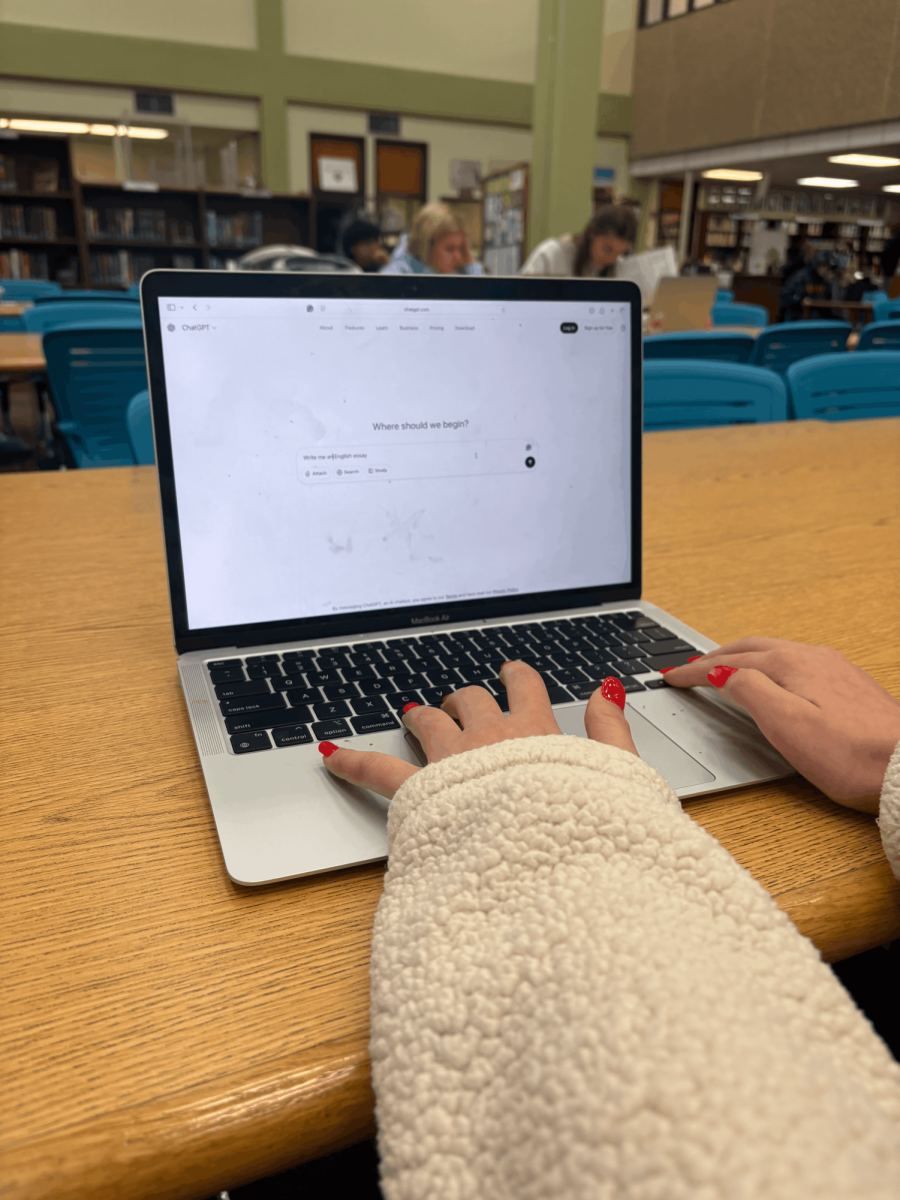
With the rise of artificial intelligence, schools are now working to preserve the integrity of students’ intellect. Cheating has never become more effortless than this advanced simulating technology, which only requires a simple, one-sentence prompt to quickly generate a completed homework assignment, a test answer, or even a detailed essay.
Artificial intelligence (AI) technology operates through high-processing computerized systems that replicate and reciprocate human intelligence. Because of its vast technological complexity, AI functions with speed and scale that far exceed human capacity, essentially making it a digitally versatile calculator. Specifically, AI’s rising popularity has made it an intriguing tool for companies aiming to stay current in this transformative era, with numerous platforms implementing it as a feature. Snapchat and Instagram are two popular social media platforms mainly used amongst younger age groups that have both included AI ChatBots that are accessible to all of their users. Now, with its gradual integration into modern life, AI has become nearly unavoidable online and offline.
Despite the surface-level perception of AI’s utility, its capabilities are superficial. AI can generate comprehensive and detailed responses from little input, but these responses often lack depth and genuine character. Regardless of this, some students see using AI as a beneficial tool for schoolwork rather than academic misconduct. As a result, students’ over-reliance on AI for the plagiarism of answers rather than a genuine understanding has created an environment where students are only passively learning through AI.
Now, with this growing dependency among students, individuals who use AI as a shortcut have become incompetent at even attempting to complete the work they are assigned, leaving educators struggling to detect what work is authentic or artificial when grading. However, some students have argued that they view AI to be the only viable solution when under the pressure of an overwhelming workload.
From an anonymous approach, one student at Austin High states, “Personally, I feel like I am unable to keep up with my schoolwork when so much is assigned in each of my classes. When I have assignments due that I do not have time for because I have so much other work to complete, sometimes I have like I have to resort to using AI because it can finish my work for me much faster.” The student expresses that when too much work is demanded, they themself feel that AI is the only reliable resource to help them maintain their grades. The student then adds, “I have noticed that a lot of my classmates also feel the same way, and they are also struggling with keeping up. It is so hard already to manage time for outside life and school life, AI seems like the only option to help lift the weight off of my chest sometimes, even if it is not right to use.” The student’s view on AI being used for schoolwork provides a closer insight into how other students are currently being affected as well by the stress of balancing their academics and their personal lives.
As AI continues to integrate itself deeper into society, its use will continue to cause controversy. The argument of whether it is morally right or not has led to ambiguity, making it difficult to recognize the negative impacts of using AI. While using AI as a replacement for completing tasks can be a quick and easily accessible shortcut, it is unethical. If this relationship between AI and students becomes the norm, current generations and generations to come’s natural sense of creativity and individuality may be significantly undermined.